For the ADHDers Who Are Feeling Everything Right Now
TL;DR: For the ADHDers Who Are Feeling Everything Right Now
When the world feels overwhelming, intense emotional distress is a common reaction for ADHD brains rather than a personal flaw. This post explains why global or social chaos hits ADHDers so hard and outlines actionable coping strategies to manage burnout.
Key ADHD Traits at Play
Justice Sensitivity: ADHDers (especially inattentive-type) often experience heightened emotional reactions to unfairness or inequality. While this brings anger, rumination, or hopelessness in dark times, it stems from a deep capacity for empathy and caring about fairness.
Emotional Hypersensitivity / HSP: Many ADHDers are Highly Sensitive People (HSPs) or empaths who absorb the surrounding collective anxiety, stress, and grief, leading to rapid emotional exhaustion.
Practical Coping & Action Strategies
Practice Self-Compassion (Kristin Neff’s Framework): Treat yourself like a friend, acknowledge shared human suffering, and practice mindfulness without judgment. There is no "perfect" way to cope.
Use the "Power of the Pause": Stop, breathe, and explicitly name your emotion (e.g., "I am noticing worry right now") using tools like the How We Feel app before taking a small, supportive next step.
Practice Balanced Gratitude: Notice small positive moments to support neuroplasticity and disrupt negative hyperfixation without resorting to toxic positivity.
Lean on Community: Resist the urge to isolate; connecting with others provides mutual support and emotional resilience.
Set News & Social Media Boundaries: Limit exposure to traumatic media (e.g., cutting back on doomscrolling apps) to stay informed without spiraling into paralysis.
Pick 1–2 Specific Actions: Counteract overwhelm by focusing your energy on small, manageable actions within your capacity (e.g., micro-donations, using 5calls.org, or volunteering) rather than trying to fix everything at once.
This week’s post is both a reminder and a plan of action for myself, and hopefully it helps some other ADHDers too.
Times feel heavy in the U.S. right now, and suffering can feel impossible to escape. I spent last weekend in a blur of tears, dissociation, and binge eating. The world felt too dark and overwhelming to imagine a way forward.
But in the words of the Princess of R&B, Aaliyah, I woke up Monday ready to dust myself off and try again. Because we don’t really have another option.
This post explores two ADHD traits that can make times like these especially difficult: justice sensitivity and emotional hypersensitivity. It also offers ways to support yourself when the emotions feel like too much.
I. Justice Sensitivity
Many people with ADHD experience justice sensitivity, or an intense emotional reaction to perceived unfairness, whether it’s directed at us or others. This can look like persistent anger or fear around victimization, a strong urge to restore justice, rumination or guilt about inequity, and feelings of hopelessness or worthlessness when faced with injustice.
Research suggests that individuals with ADHD, particularly inattentive-type ADHD, tend to be more justice sensitive than neurotypicals. While there’s no single explanation, contributing factors may include:
Given the current climate, injustice feels constant and inescapable. If you’re struggling more than usual, you’re not broken, and you’re not alone. One reframe that can help: justice sensitivity exists because you care deeply about fairness and other people. That’s a strength. Just remember that caring for others also requires caring for yourself.
II. Emotional Hypersensitivity / Highly Sensitive People
In addition to justice sensitivity, many ADHDers experience emotional hypersensitivity, and some identify as empaths or highly sensitive people (HSPs).
Highly sensitive people tend to be deeply attuned to the emotions and moods of those around them and may absorb emotional energy more easily. This can be an incredibly compassionate trait, but it can also be exhausting during a time when we are witnessing widespread suffering in real time and the people around us are more stressed, anxious, and depleted.
III. Be Intentional About Self-Care Right Now
So what do you do with all of this big emotional energy when it hits?
To reduce burnout, especially when justice sensitivity and emotional hypersensitivity are activated, it’s essential to be intentional about how you care for yourself.
Have self-compassion
When your reactions don’t feel “productive enough,” practice self-compassion. Using Kristin Neff’s framework from her work on self-compassion, this means:
1. Being kind to yourself the way you would be to a close friend
2. Remembering that suffering is part of our shared human experience
3. Practicing mindfulness: acknowledging painful emotions without ignoring them or becoming consumed by them
Many of us have never lived through chaos like this. There is no gold-star way to cope.
Pause and name your emotions
Pausing regularly to identify what you’re feeling helps regulate big emotions. Many ADHDers skip this step, which makes rumination and overwhelm even harder to manage.
One tool I often recommend to clients (from the ADD Coach Academy) is the Power of the Pause: stop, breathe, notice your thoughts and feelings, name the specific emotion, and then choose a supportive next step.
For example: When you notice your heart rate go up or your thoughts spiraling, take one slow breath and say to yourself “I’m noticing worried right now.” Then choose one small supportive next action.
A simple tool I personally love for this is the free app How We Feel.
Practice gratitude
Gratitude can feel impossible right now, but noticing even small positives helps support neuroplasticity and counter the ADHD brain’s tendency to fixate on what’s going wrong.
This isn’t toxic positivity. It’s about balance.
Lean on your community
This isn’t ADHD-specific, but it’s essential. Community is a form of resistance. This is a time to connect, not isolate. You don’t have to carry this alone.
Decide when and how much news you consume
This is hard, and you won’t do it perfectly. Still, deciding how much negative news you allow in can make a real difference.
For me, that’s meant almost entirely eliminating Facebook and Instagram and working on reducing Reddit. I want to stay informed, but I don’t need constant exposure to traumatic content to care or take action. Too much social media sends me into a dark spiral that ultimately makes me less effective.
Decide what action you’re capable of taking
Overwhelm grows when everything feels urgent and undefined. Choosing one or two ways to act, based on your capacity, can help.
That might mean donating money, volunteering, attending protests or other forms of civic engagement, or calling representatives (5calls.org is a great resource). You don’t have to do everything. Having a plan gives your energy direction and helps anchor you when the weight of everything starts to feel unbearable.
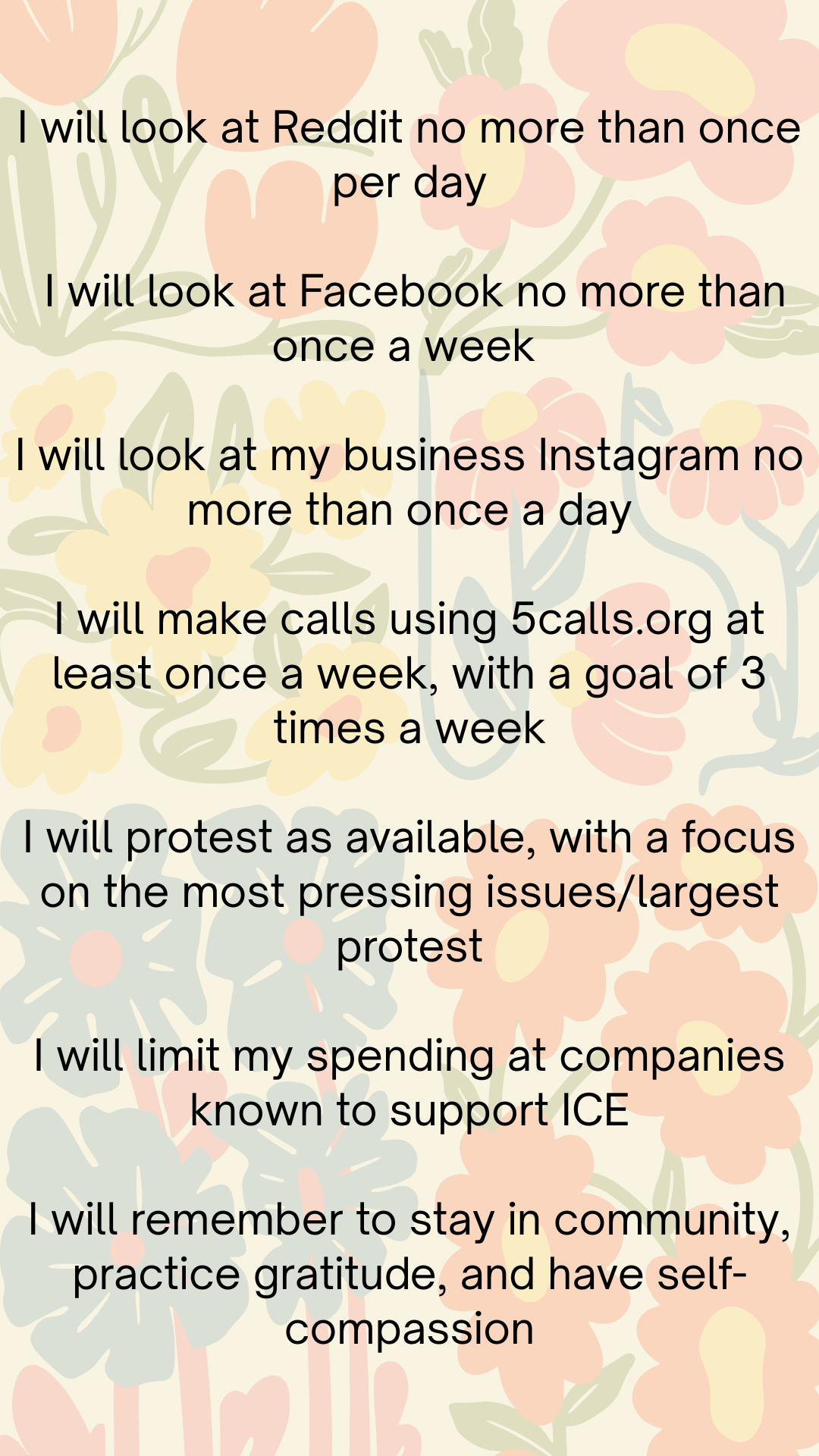
My intention for this time
After a very emotional weekend this week I sat down and made a plan for how I will take care of myself during this time. I turned that list into a phone wallpaper and made it my home screen on my phone.